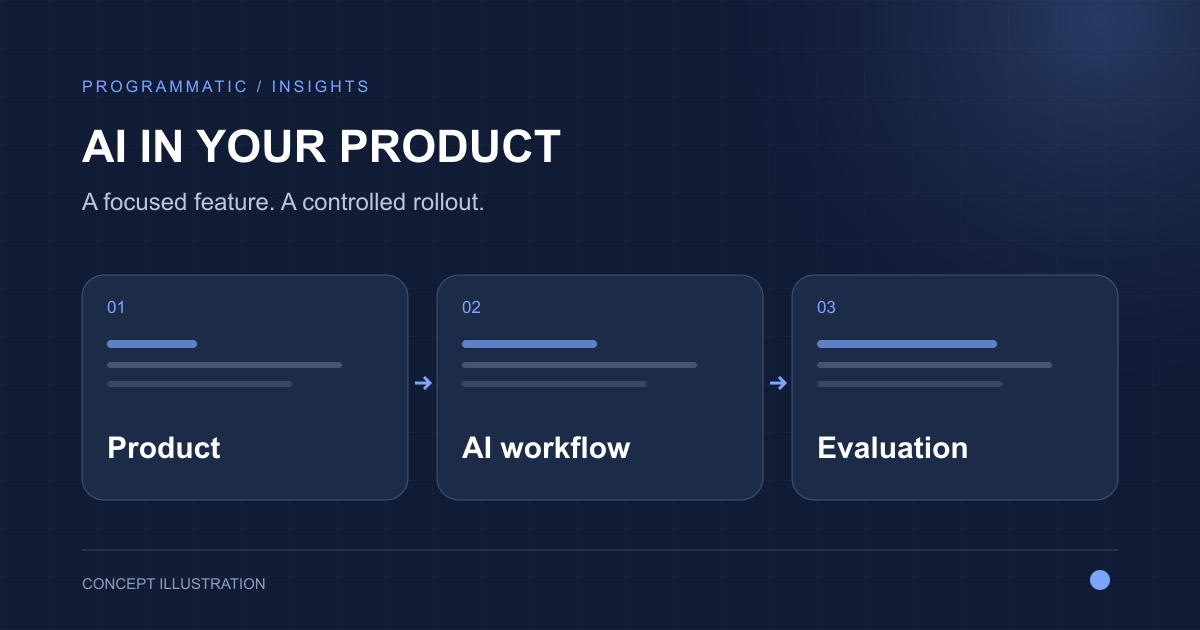
Adding AI to an existing product rarely requires replacing the product. A safer and usually faster path is to identify one workflow where model capability can improve an existing task, place that capability behind the product's current permissions and business rules, and evaluate it against representative examples before expanding the scope. The AI layer should strengthen the product architecture, not become a second uncontrolled product beside it.
What an AI-assisted MVP actually is
An AI-assisted MVP is a production-minded first version of a product workflow that uses model capability where it creates clear value, while keeping the surrounding application, identity, data, approvals, and business logic explicit.
It is different from a prompt demo. A demo proves that a model can sometimes perform a task. An MVP tests whether the entire workflow can perform reliably enough for real users and whether the improvement is worth the operational cost.
First ask whether the problem needs AI
Some product problems are better solved with search, deterministic rules, a new data model, workflow automation, or clearer interface design. AI is useful when the task benefits from language understanding, extraction, classification, generation, ranking, pattern recognition, or flexible reasoning over context.
Define the existing pain before choosing the model. If the success condition can be implemented more reliably with normal software, use normal software and reserve AI for the part that genuinely needs it.
Choose one high-value use case
The first AI feature should have a clear user, input, output, and decision boundary. Good starting points include summarizing a known record set, extracting fields from a known document family, drafting a response from approved knowledge, classifying an incoming item, or recommending a next action for human review.
- Name the user and the task
- Define what a correct output looks like
- List the source systems and permissions
- Document unacceptable failure modes
- Decide when a person must review or approve the result
Use the simplest model strategy that can meet the requirement
Most teams should begin by testing capable hosted models before investing in fine-tuning or custom model infrastructure. Retrieval, structured tool calls, deterministic validation, and better context often solve problems that initially look like model-training problems.
Escalate the architecture only when evaluation shows a real limitation: unacceptable behavior, domain-specific output requirements, latency, privacy, cost, or deployment constraints that the simpler approach cannot address.
Treat data access and permissions as product architecture
The model should not receive every piece of data the application can reach. Map which records, documents, user attributes, product state, and business systems are necessary for the task and apply the same permission boundaries the rest of the product depends on.
For retrieval-based features, source quality and access filtering matter as much as prompt wording. The product needs a clear answer to which source was used, whether the user was allowed to see it, and how stale or incomplete the source might be.
Build an evaluation set before broad release
A useful evaluation set contains representative normal cases, edge cases, ambiguous requests, bad inputs, and examples where the correct behavior is to refuse, escalate, or ask for more information.
Measure the behavior that matters for the workflow rather than one generic accuracy number. Extraction may need field-level correctness, retrieval may need source relevance and groundedness, and an agent may need correct tool selection, permission behavior, escalation, and final outcome quality.
- Create examples from real workflow patterns
- Write expected outputs or acceptance criteria
- Include known failure modes
- Evaluate changes to prompts, models, retrieval, and tools against the same set
- Keep a human review path for high-impact outputs
Design human oversight into the workflow
Human review should not be an emergency feature added after a model fails. Decide which actions AI can complete automatically, which outputs need confirmation, and which situations should always move to a person.
The higher the consequence of an incorrect result, the stronger the review, logging, and approval controls should be. Product design should make those boundaries clear to users rather than implying certainty the system does not have.
Keep the AI layer replaceable
Do not let model-specific prompt code, credentials, provider APIs, and tool logic spread throughout the product. Put model access behind a service or interface that the rest of the application can call through a stable contract.
That separation makes it easier to change models, route tasks between providers, introduce fallback behavior, add evaluation and logging, and keep business rules independent from model behavior.
Instrument the AI feature like a production system
AI observability should connect technical behavior to the user workflow. Track model and tool errors, latency, token or inference cost, retrieval results, user feedback, escalations, refusal behavior, and the final product outcome where possible.
Logs need privacy and retention controls of their own. Avoid storing sensitive prompt or response data by default merely because it is useful for debugging.
Design for cost and latency before usage grows
A feature can feel inexpensive at prototype volume and become costly when every user action triggers multiple model calls, retrieval steps, and tools. Measure the cost per successful workflow, not just the price of one request.
Latency is equally important. Stream responses where it improves usability, parallelize independent work, cache only where it is safe, and reserve expensive model paths for tasks that need them.
Create an explicit learning loop
Production AI does not automatically become better merely because people use it. Improvement requires an operating loop: capture useful feedback, classify failures, update prompts, data, routing, tools, or models, and evaluate the change before release.
Treat that loop like normal product engineering with owners, test cases, release notes, monitoring, and rollback options.
Know when the MVP is ready to scale
Scale when the workflow is valuable, the common failure modes are understood, evaluation is repeatable, permissions are correct, operational ownership exists, and cost and latency are acceptable for expected usage.
Expansion can then happen one dimension at a time: more users, more document types, more tools, more autonomous actions, or another workflow. That is safer than increasing every dimension simultaneously.
A practical implementation sequence
A staged implementation keeps the AI portion narrow while making the surrounding product controls production-ready from the beginning.
- Map the workflow and success criteria
- Prototype the smallest model interaction
- Connect only the required data with existing permissions
- Build a representative evaluation set
- Add deterministic validation and human review
- Instrument latency, cost, errors, and user outcomes
- Release to a constrained user group
- Review failures and improve the architecture
- Expand autonomy or scope only when evidence supports it