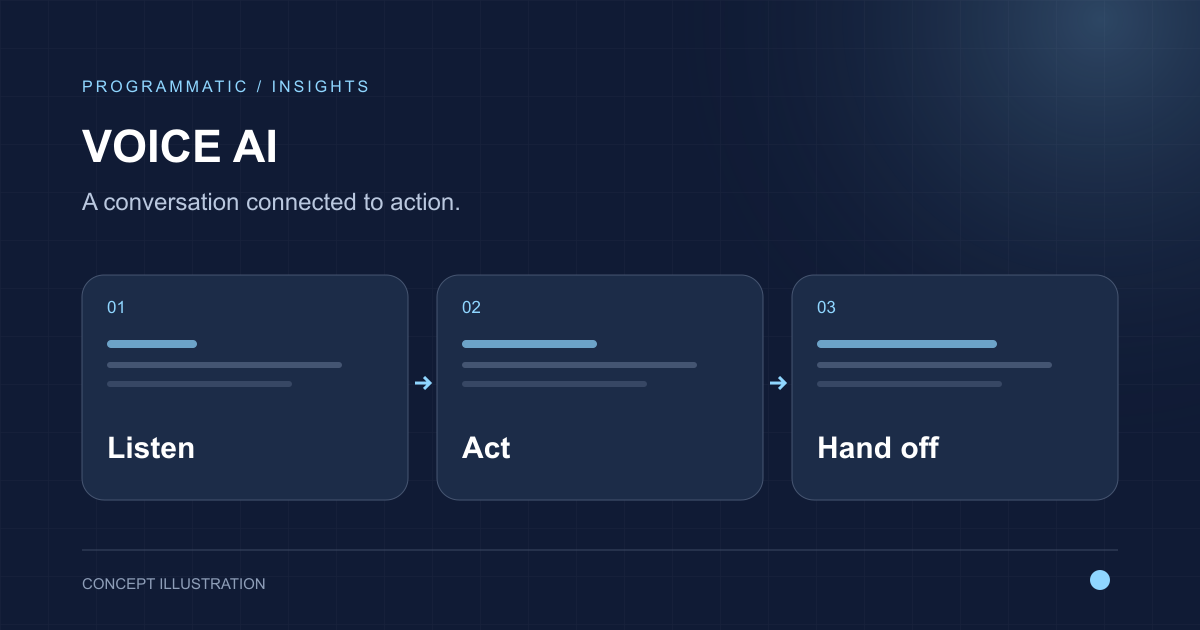
A business voice agent is not just a speech interface to a language model. It is a real-time system that has to hear accurately, respond quickly, use business context, complete approved actions, handle interruptions, and transfer to a person when the conversation moves outside its safe operating boundary.
Choose workflows with clear call intent
Appointment handling, qualification, status checks, routine support, reminders, and structured intake are easier to evaluate than open-ended conversations with unclear ownership.
Latency changes the user experience
Speech recognition, model reasoning, tool calls, text-to-speech, network behavior, and turn-taking all contribute to delay. A voice architecture has to be designed around conversational timing, not only answer quality.
Integrations make the agent operational
Useful agents often need CRM records, scheduling, order or account systems, ticketing, identity checks, and internal APIs. Permissions should be limited to the actions the workflow actually requires.
Human transfer is part of the design
Escalation should define when a person takes over, what context is passed, how the caller is informed, and what happens if transfer is unavailable. This is especially important for sensitive or high-impact calls.
Evaluate conversations, not isolated answers
Measure task completion, intent handling, transcription errors, interruption behavior, tool use, transfer quality, latency, and failure recovery across representative call scenarios.