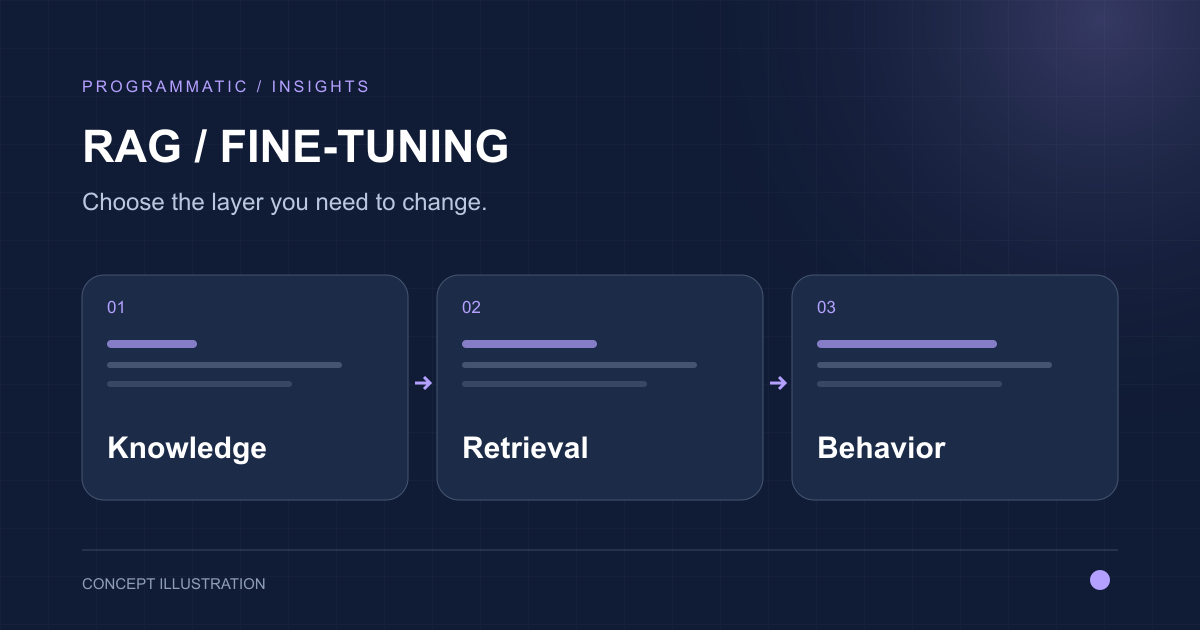
RAG and fine-tuning solve different problems. Retrieval-augmented generation gives a model access to external information at request time. Fine-tuning changes model behavior by training on examples. Choosing between them becomes easier when the requirement is separated into knowledge, behavior, and operating constraints.
Use RAG when the problem is access to changing knowledge
If answers depend on documents, policies, product information, customer records, or other information that changes over time, retrieval is usually the first architecture to test. The source can be updated without retraining the model.
- Fresh or frequently changing information
- Source-specific answers
- Permission-aware knowledge
- Need for citations or traceable context
Use fine-tuning when the problem is repeatable behavior
Fine-tuning is more relevant when the goal is consistent style, formatting, classification behavior, or a specialized response pattern that can be demonstrated through enough high-quality examples.
Do not treat either approach as a substitute for evaluation
RAG can retrieve the wrong context. A fine-tuned model can generalize poorly. Build evaluation sets that represent the actual task and measure retrieval quality, answer quality, failure modes, latency, and cost.
Hybrid architectures are common
A system can use retrieval for knowledge and a tuned model for behavior. The additional complexity is justified only when measured limitations of the simpler system make it necessary.
Choose based on the operating model
Consider who updates knowledge, how sensitive data is handled, where models run, how often behavior changes, what observability is required, and how the system will be maintained after launch.